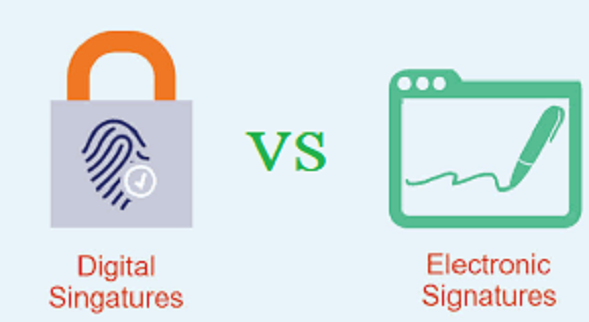
In today’s digital world, signing documents online has become a routine part of business and government processes.
However, many people get confused between Digital Signatures and Electronic Signatures (e-signs). While both are used to authenticate documents, they differ in security level, legality, and technology.
Let’s break down the differences and understand which one is right for you.
A Digital Signature is a secure and legally recognized form of signing an electronic document using cryptographic technology.
It uses Public Key Infrastructure (PKI) to verify the identity of the signer and ensure that the document has not been tampered with after signing.
In India, Digital Signature Certificates (DSCs) are issued by licensed Certifying Authorities (CAs) such as eMudhra, VSign, PantaSign, Capricorn, and SpeedSign, under the Information Technology Act, 2000.
An Electronic Signature (or e-sign) is a simpler way to sign digital documents using electronic methods such as Aadhaar OTP verification, scanned image, or click-to-sign options.
It is used for quick document approvals and everyday business needs.
While e-signs are convenient, they do not provide the same level of identity verification and data integrity as a Digital Signature.
| Feature | Digital Signature Certificate (DSC) | Electronic Signature (e-Sign) |
|---|---|---|
| Legality | Legally valid under IT Act, 2000 | Also valid under IT Act, 2000 |
| Security Level | High – Uses encryption and PKI verification | Moderate – Uses Aadhaar or email verification |
| Identity Verification | Verified by Certifying Authority (CA) | Verified by Aadhaar or email |
| Storage Medium | Stored in a secure USB token | No physical storage required |
| Common Usage | MCA, GST, DGFT, Income Tax, Tenders | Internal approvals, HR forms, contracts |
| Tamper Protection | Yes – Detects any modification after signing | Limited tamper protection |
| Issuing Authority | Licensed Certifying Authority (CA) | e-Sign Service Provider |
| Cost | Paid certificate (1, 2, 3 years validity) | Usually free or low cost |
For most legal and government purposes in India, a Class 3 Digital Signature Certificate is mandatory and offers higher security and authenticity.
Yes, both are legally valid under the Information Technology Act, 2000. However, a Digital Signature Certificate is required for official filings and government portals, while an e-Sign is sufficient for internal use.
A Digital Signature is more secure because it uses encryption and PKI verification, ensuring the signer’s identity and document integrity.
No, government portals like MCA, GST, DGFT, etc. Require a valid Class 3 Digital Signature Certificate issued by a licensed Certifying Authority.
No, an e-Sign doesn’t have a validity period. However, each use requires fresh Aadhaar or OTP authentication. A Digital Signature Certificate has a fixed validity of 1 or 2 years.